Skip to content
  • The live product on a phone: fifteen minutes with a founder shows it.
  • Engine tested against reference values from NASA JPL Horizons, last run 25 Sep 2026: 19 checks (16 against Horizons, 3 on the sidereal offset), Moon within 0.011°, Sun within 0.009°.
  • Historical snapshot, measured 25 Sep 2026: 32 accounts and 0 paid orders at that time. First paid INNER orders have since been verified.

02 · The problem

A personal reading still leaves a decision about timing.

People already open an app every day. The open question is what it gives back.

A person has a real decision on the calendar: sign a paper, have a hard talk, ask for a raise, or rest. Personalized daily readings already exist. The person still needs to connect this particular choice to an hour and, later, to their own record.

A personal timing answer needs a clear basis. When calculation and explanation are blended, a user cannot tell which parts are computed and which are interpretation.

So we built AMAYA around one narrow question: which hours of my day fit this action?

  • An answer with no time attached leaves the decision where it started.
  • A timing recommendation is easier to examine when its calculated inputs and interpretation are distinct.
  • A product that promises an outcome loses trust on the first day that goes another way. We promise clarity and time.
See how the product works →

Scroll to section 3.

03 · The product

One habit, two touches a day: a morning read and an evening mark.

What you see on the phone, and what you do with it.

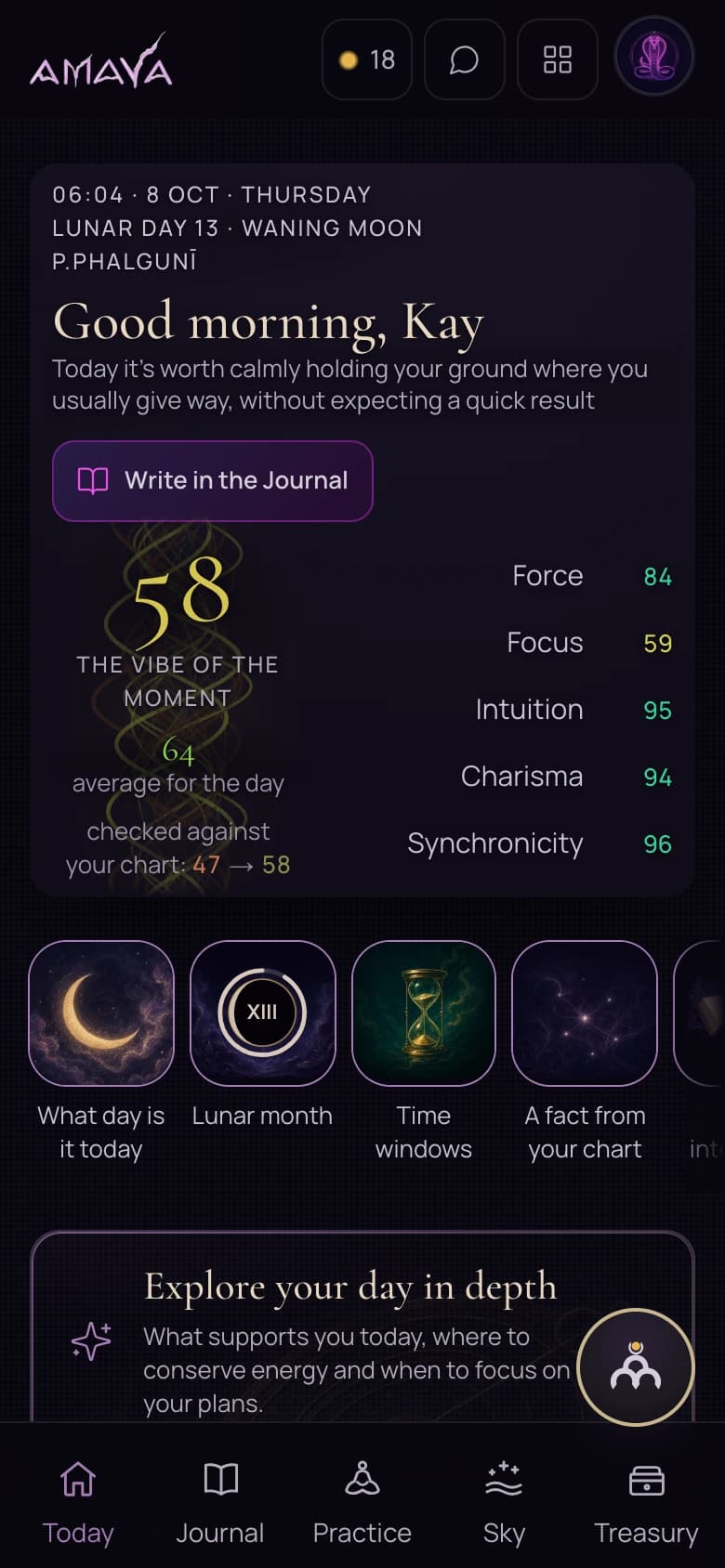
Morning. The person opens Today: the day as a wave, five forces, advice in plain words, and a schedule of hours to act and hours to wait, each with minutes. This layer is free forever.

Ask the Sky. The person types a real question, for example whether to sign today. The answer comes with a time to take the step, and never a promise of how things end.

Evening. The person marks whether the day fit. Over weeks they see their own hit rate, counted from their word alone. That closes the loop: a morning read, an action, an evening check.

Journal. With the person's consent, a language model reads the journal entries so that answers are more precise. The text goes to our model provider (Anthropic), and the model does not quote it. One switch turns the reading off.

  • Free forever: the day by the hour, sky maps, the day score.
  • Paid: deeper readings, priced in PRANA, our internal credits, with the price small in the corner of each action.
  • Trust: consent for AI comes before the first question, and a complaint control on every answer is in the code (App Store guidelines 1.2 and 5.1.2); no store submission has been made yet. The web version works now.
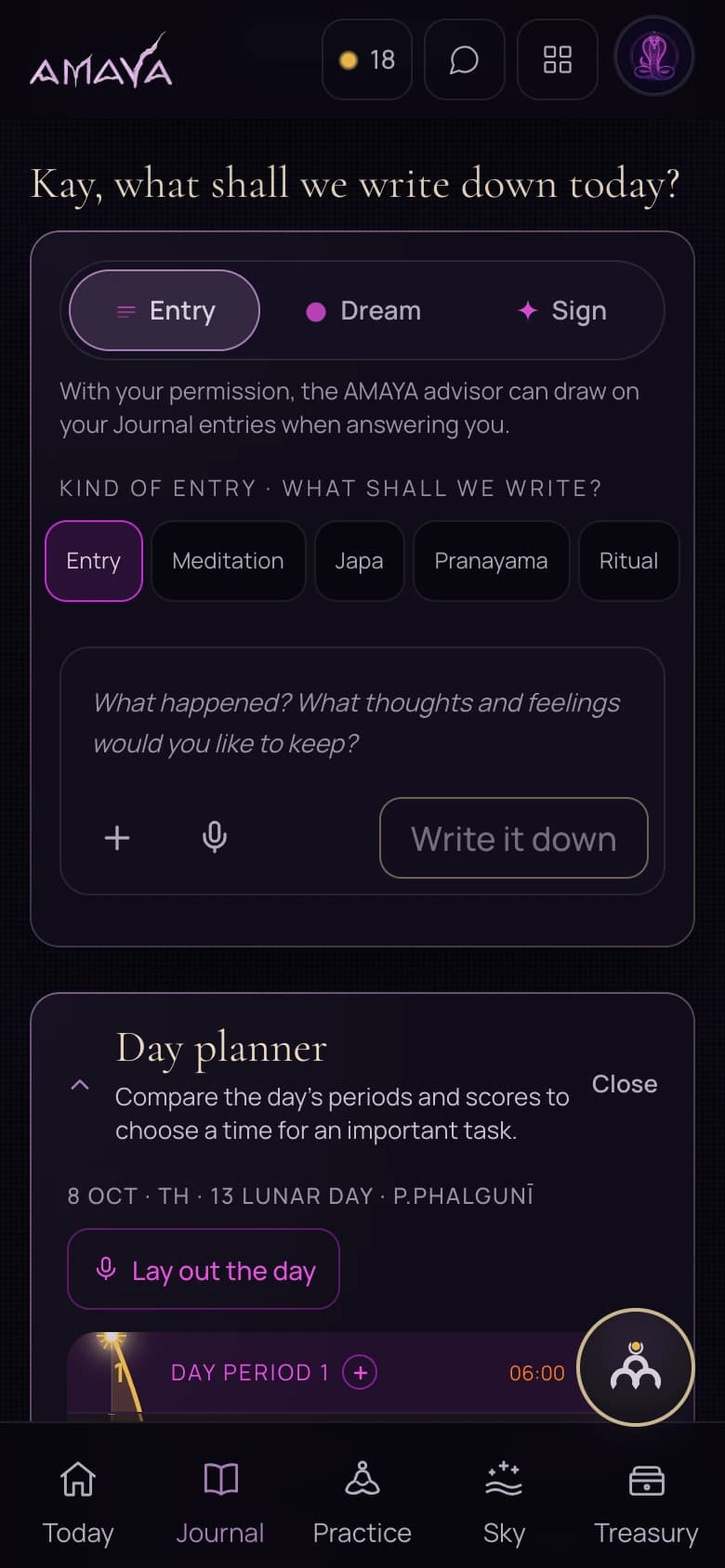
The live Today screen on a phone.
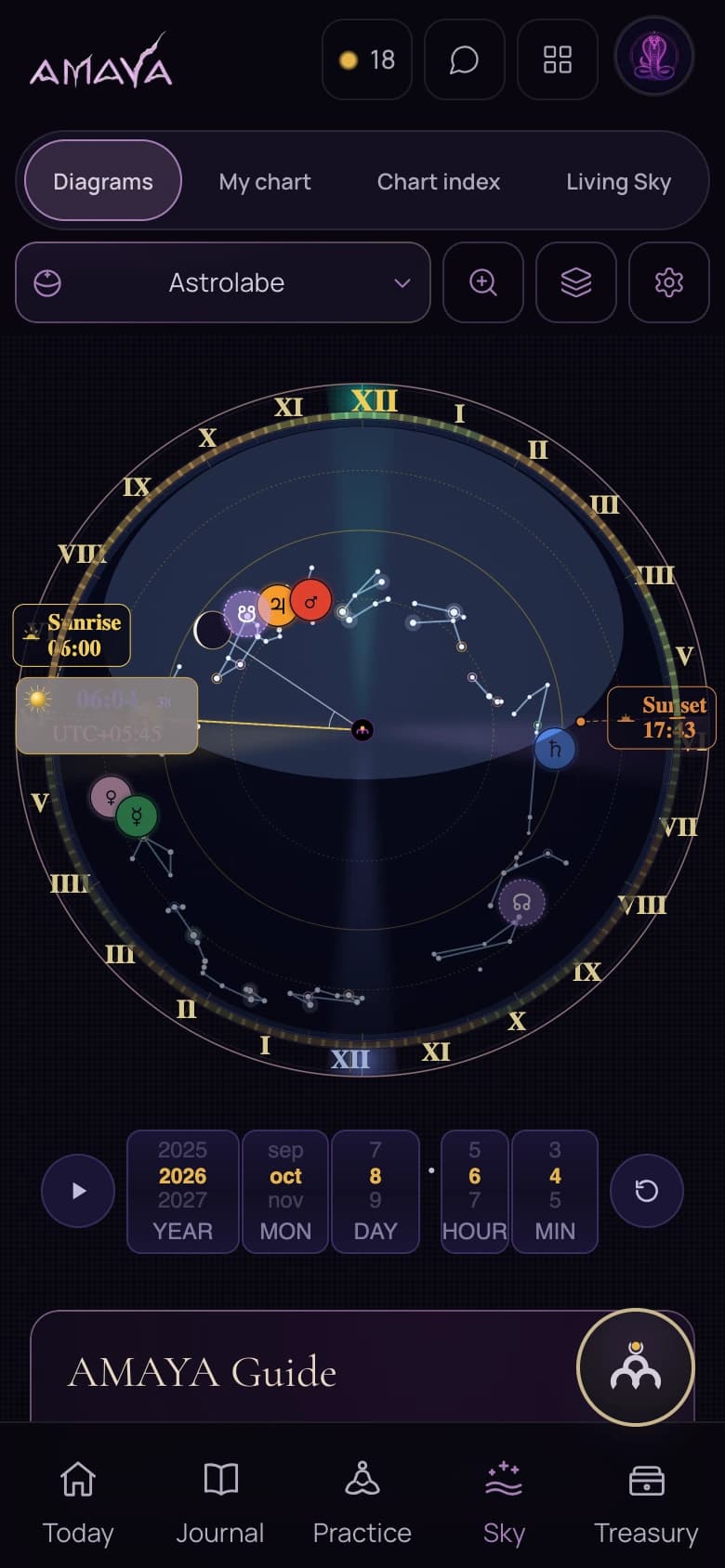
The live Sky screen on a phone.
The live Journal screen on a phone.
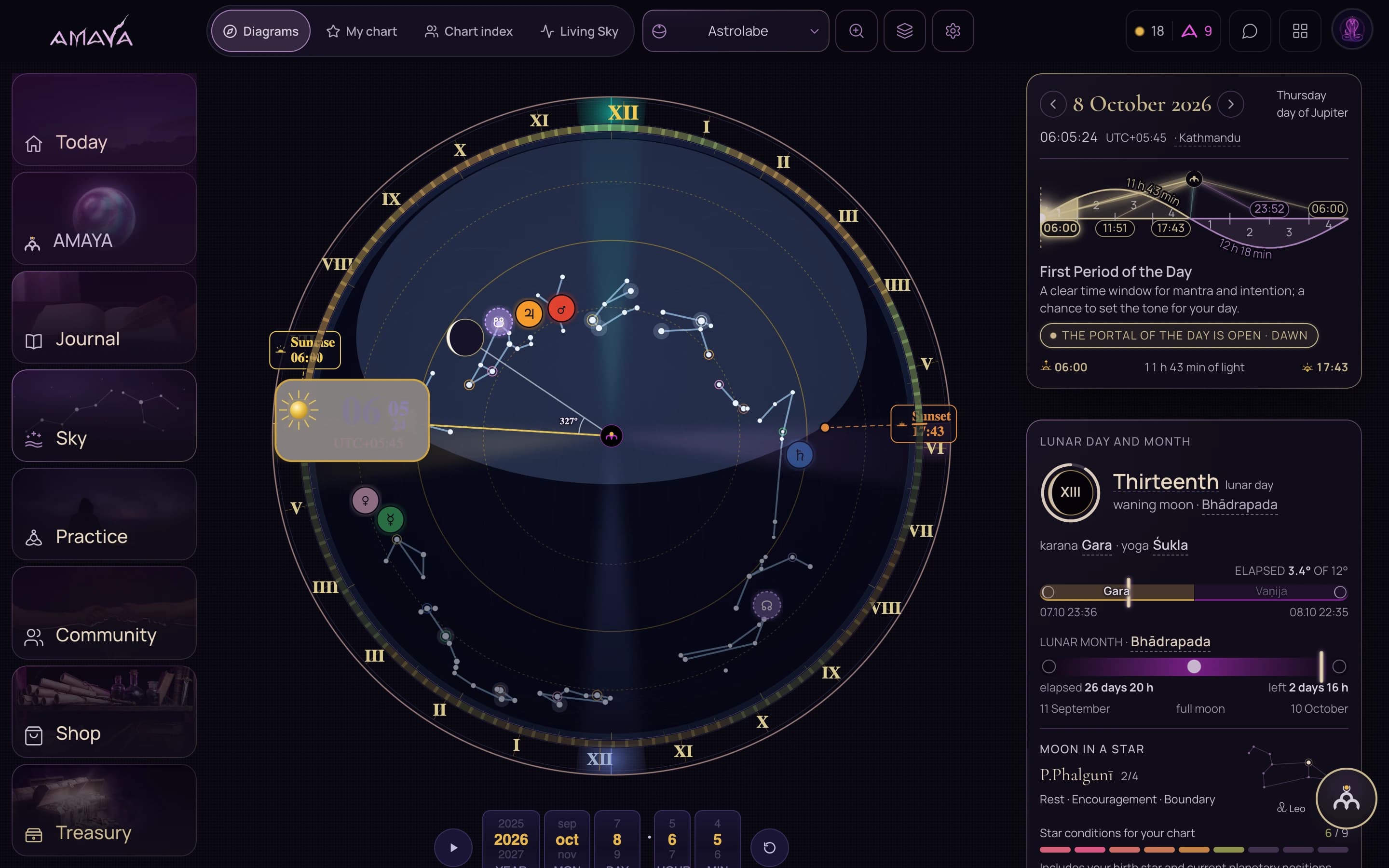
The live Sky screen in English on a wide display.
Sky on a larger screen - the same calculation in a detailed view

Real app screens captured on 8 October 2026 with a demo profile. No private user entries are shown.

See it live on a call →

We open the app on a phone and show nothing we cannot open on the spot.

see a result

A chart you can inspect. A reading you can follow.

These two examples come from the app. Look at the markers, read the conclusion, then open the complete card to see what informed it.

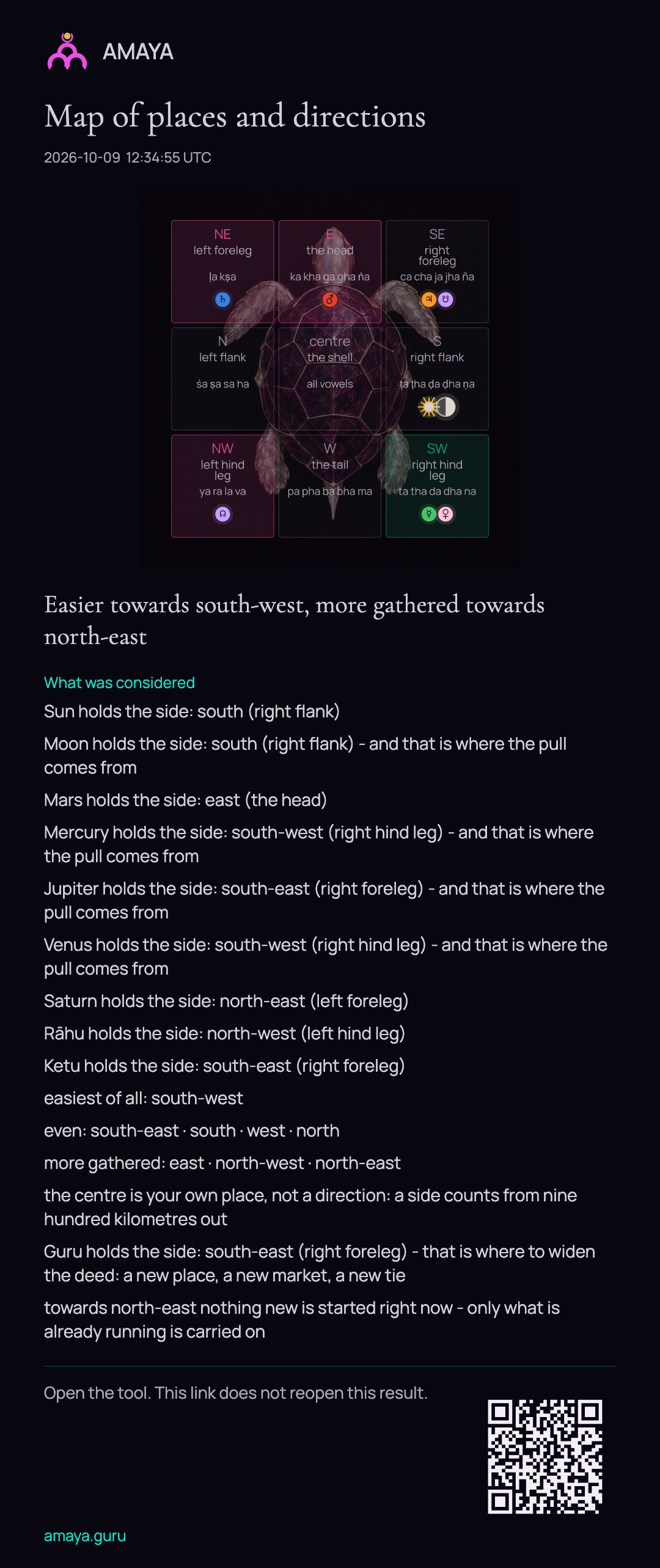
Places and directions

For comparing directions when considering a trip or a move.

Example Map of places and directions: tortoise grid, planet markers and the beginning of the conclusion. The link opens the complete result.
Card preview using demonstration dataOpen the complete example
  • The grid connects each marker to a direction.
  • A short conclusion sits below the chart for the selected moment.
  • The complete card lists the positions used in the calculation.

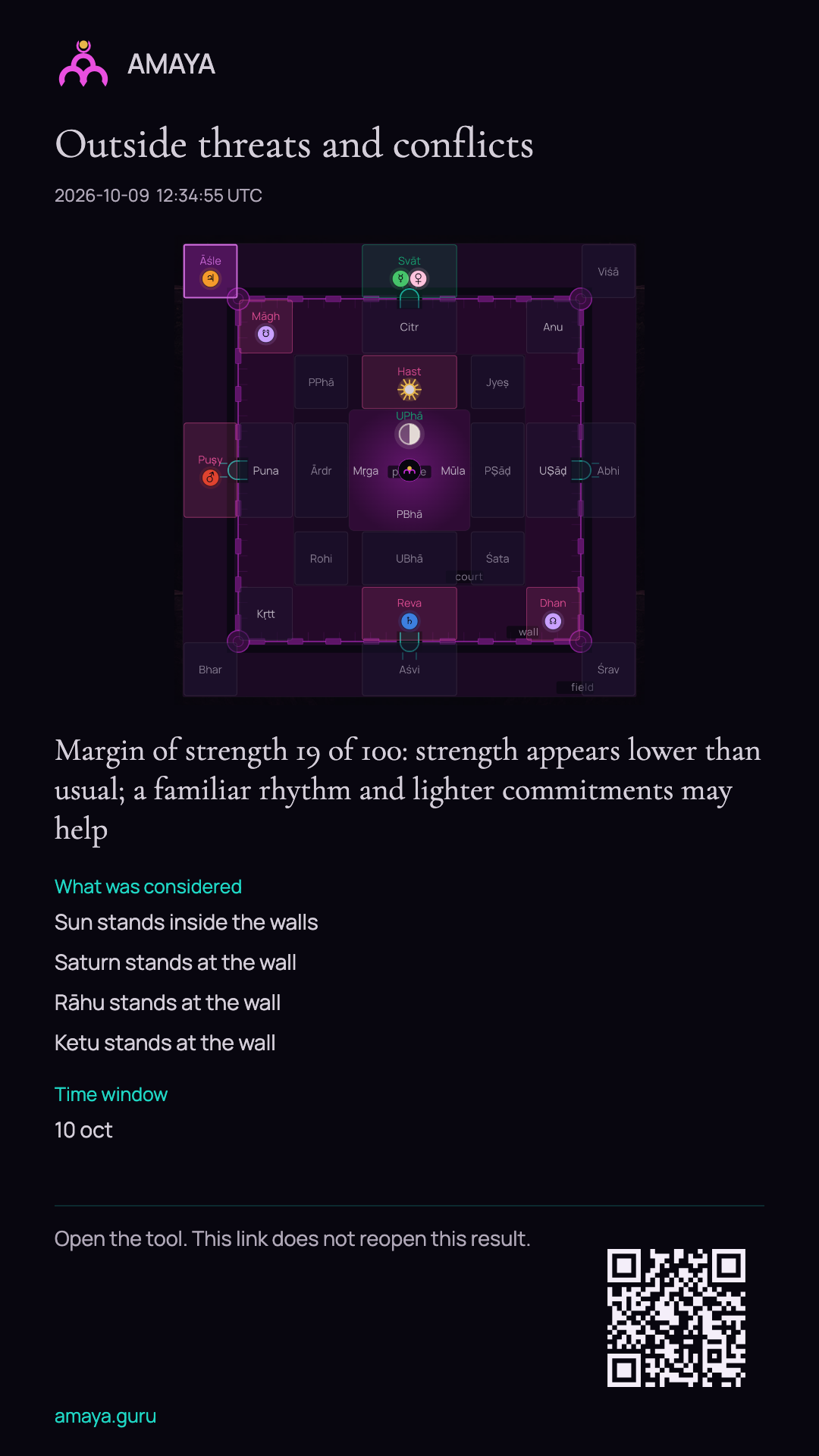
Pressure and capacity

For looking at a demanding situation and your margin of strength.

Example Outside threats and conflicts reading: fortress chart and the beginning of the conclusion. The link opens the complete result.
Card preview using demonstration dataOpen the complete example
  • The fortress shows markers inside its walls and along its boundaries.
  • The conclusion turns the calculation into a suggestion about your workload.
  • The complete card includes the factors considered and the period covered by the reading.

These are saved calculations using demonstration data, not personal readings for you. The date, markers and conclusions belong to these examples. Each QR code opens the AMAYA tool, not the saved result.

04 · Historical baseline

Historical database and code snapshot, measured 25 Sep 2026.

Historical database and code snapshot dated 25 Sep 2026. Current paid INNER orders are verified; recurring payment and cohort metrics remain unverified.

Historical snapshot, 25 Sep 2026. The database then showed 32 accounts and 0 paid orders out of 45: 43 waited for payment and 2 were declined. The 45 attempts came from 11 people between 12 Jun and 18 Sep 2026, including the team and first circle; none succeeded. Seven people tried more than once, and one tried twelve times. These figures describe that date only. The first paid INNER orders have since been verified.

Historical activity, 25 Sep 2026. In the prior 7 days, 3 signed-in people produced events; 9 questions to the sky had been sent across all time. Of guests' first touches, 95% came from machines (336 of 352, measured 23 Sep 2026). These figures are not a current activity or acquisition series.

Historical measurement note. The daily snapshot then showed 1 paying user while orders showed 0 because it counted an entitlement, not a payment. Current paid-order status is based on verified INNER orders.

Calculation test, last run 25 Sep 2026. The engine passed 19 checks against NASA JPL Horizons reference values: 16 comparisons on eight dates and 3 sidereal-offset checks; Moon within 0.011° and Sun within 0.009°, exit code 0. This is a dated test sample.

  • Historical prelaunch AI spend measured by 25 Sep 2026: $45.67 over 30 days, about $77 a month on the latest week at that time.
  • Historical distribution plan as recorded 25 Sep 2026: BetaList on 25-26 Sep and Product Hunt on 1 Oct 2026 at 00:01 PT. This records the plan, not confirmation of execution.
  • Current verification priorities: verify a repeat payment cycle, gather consecutive usage cohorts and measure language-model feature costs. Retention, acquisition cost and margin have no current cohort series.
Ask for the live numbers on the call →

We recount the database on the day of the call.

05 · How we make money

A free daily layer, two paid tiers, and one big cost line we name.

Prices are decided. Everything about margin is still a model.

The free layer earns the habit. INNER costs $29 a month, or 79 for 3 months, 149 for 6 months, 249 for a year, in USD, with a 3-day trial; the no-card path still needs confirmation. ACADEMY costs $108 a month, or 297 for 3 months, 540 for 6 months, 972 for a year, in USD, with no trial. Deeper actions cost PRANA, internal credits people earn by practice or buy, and they never convert back to money.

Our model uses $26 a month per paying user. It is a planning decision by Kalanath, not an observed average from the first paid orders.

Heralds earn 20% of an invited person's payments plus 5% from the second level, for 12 months from that person's first payment, with a combined limit of 25% across both levels. Earnings sit on an internal balance (AMAYACOIN), and withdrawal opens from 250 USD after 30 days.

Dated model, 25 Sep 2026. At milestone 1, the model put AI cost at $10,243 a month in the base case, or 98% of modeled MRR, with 39% in the low case and 336% in the high case. These are model outputs, not measured current margin. Current cost and margin require usage-cohort measurement.
  • Milestone 1, a model target and not a forecast: 10,000 monthly actives at 4% paying gives 400 paying and about $10,400 MRR.
  • Seed milestone, a model target and not a forecast: $35,000 MRR, about 1,350 paying at $26.
Discuss the unit-economics model →

One page: prices, the cost model, what we measure.

06 · Market hypothesis

A daily product must earn a place in someone's routine.

Repeat use and distribution still need evidence.

AMAYA is testing whether a day-by-hour view, personal questions and a Journal give people a useful reason to return. Return visits and channel contribution remain to be measured.

  • The product hypothesis is that people want to connect a specific question, a suitable time and their later observation.
  • The team is testing the open day view, referrals, shareable material and community partnerships as possible ways to reach those people.

The contribution of each channel and the size of the reachable audience still need evidence. We will use measured cohorts to guide distribution.

Ask how repeat use will be measured →

We can walk through the current measurement priorities.

07 · Why now

The product is live; the next step is repeat-use evidence.

A working beta and first paid INNER orders, with repeat use and economics still to measure.

Our computation is ours. The engine counts and the model only explains, so the numbers are the same for the same inputs and can be checked. Consent before the first AI question and a complaint control on every answer are already in the code.

Current verification priorities. Verify a repeat payment cycle, gather consecutive usage cohorts and measure language-model feature costs. These will provide evidence on retention, acquisition cost and margin.

  • We promise no growth we have not measured.
Request a conversation →

Fifteen minutes, on a phone, with a founder.

08 · The team

Two founders, parallel AI agents, and the team question named first.

We say the weak spot first.

Two founders. Kalanath D'Aysén leads the product, the teaching and the voice. He carries and teaches a living tradition from Kashmir, and he is the author of the method and of every text in the product. Rustam Rakhmanov leads operations, legal and finance, and is general manager and legal representative of AMAYA Patagonia SpA in Chile. The software is built with parallel AI agents that Kalanath directs.

The team question comes first. The team is small. An angel is right to ask what happens if the person carrying the product is unavailable. We have two founders, but the product and the teaching rest on Kalanath, while operations, legal and finance rest on Rustam. There is no backup person for the product until real people are named, and we claim no key-person insurance.

Model dependency. Today every model call goes directly to one provider, Anthropic. Moving all calls behind a shared layer that can switch providers is a plan, and it is not built.

  • Build: Kalanath directing parallel AI agents for code, tests and editing.
Ask for the who-does-what sheet →

One page: roles, owners of each area, open roles.

09 · After the first call

Terms

Terms are shared personally after a first conversation.

Request a conversation →

Fifteen minutes, on a phone, with a founder.

10 · For you

For an angel: what you can verify in the product yourself.

A live beta, verified first paid orders, and clear questions for the next stage.

You are likely looking at consumer, wellness or AI-companion deals on your own, with no committee. So we built the first conversation for that angel.

A product you can hold. In fifteen minutes we open the live app on a phone, show it, and take your questions. You judge the daily habit yourself.

Current paid status. The first paid INNER orders are verified. Repeat payment, retention, acquisition cost and margin still need cohort evidence.

  • Verify: the engine test against reference values from NASA JPL Horizons, and a live run on your own city.
  • Next step: after the conversation, terms are shared personally.
  • Weigh: a small team with the product resting on Kalanath, alongside unverified repeat payment and cohort economics.
Request a conversation →

We book fifteen minutes and bring the phone.

11 · Objections and answers

The six sharpest questions, answered plainly.

Each answer says what we know, what we do not, and what we will show.

How many people pay?

The first paid INNER orders are verified. A repeat payment cycle, retention, acquisition cost and margin are not yet established by cohort data. Historical baseline: on 25 Sep 2026 there were 32 accounts and 0 paid orders out of 45 attempts; that is not the current order count.

Is this a fortune-telling app with AI?

AMAYA reads time by the position of the sky and promises no outcome. It computes the Sun and Moon over a person's town with its own engine, tested against reference values from NASA JPL Horizons, and turns that into a rhythm of the day. The model only explains finished numbers. On top of the count sits an interpretation layer, a question-and-verdict format and spreads, and we mark where the count ends and the interpretation begins.

Who is on the team?

Two founders. Kalanath D'Aysén leads the product, the teaching and the voice. He carries and teaches a living tradition from Kashmir, and he is the author of the method and of every text in the product. Rustam Rakhmanov leads operations, legal and finance, and is general manager and legal representative of AMAYA Patagonia SpA in Chile. The software is built with parallel AI agents that Kalanath directs. The team is small, and the product and the teaching rest on Kalanath. There is no backup person for the product until real people are named. What is built so far is listed in section 4.

Where is the margin?

The dated 25 Sep 2026 milestone-1 model put AI cost at 98% of modeled MRR in the base case, from 39% to 336% across cases. Those are model outputs, not measured current margin. Actual cost and margin need usage-cohort data.

Will the app stores accept it?

The web version works now. Consent before the first AI question and a complaint control on every answer are in the code, built to App Store guidelines 1.2 and 5.1.2. No store submission has been made, so we make no claim about approval.

How does the land in Chile relate to the app?

The land and AMAYA Patagonia SpA are a separate company and a separate project. The company behind the app is a Delaware C-corp, in formation, and the two companies are not linked by shares.

  • Every answer ends with something we can show on the call.
  • The full ten questions are in our objections sheet.

Fifteen minutes. One request.

Give us one call.

Write to us, and we book fifteen minutes. We open the live product on a phone and answer your hardest questions. We share terms personally after the first conversation. If the product does not fit, you know why within a quarter of an hour.

The answer to your first message comes from Kalanath D'Aysén himself.

  • One request: fifteen minutes.
  • You leave with answers to your own questions.

AMAYA · materials for investors

This material is for discussion only. It is not an offer to sell, or a solicitation of an offer to buy, any security. Any offer is made only by separate documents and only to those to whom it may lawfully be made. Milestones and models are targets, not forecasts.