Attention and everyday practice
How to notice a familiar reaction and choose another response
Choose one recent episode and separate the event, your inner response and your action. Then prepare one concrete response to try in a similar situation.
- The event
- Your inner response
- Your chosen answer
Sometimes a familiar response becomes clear only after a conversation: agreeing too quickly, a sharp tone or silence. That moment of noticing is a place to start. Choose one episode you want to understand and work through it step by step.
Choose one episode
Describe what happened so that another person could picture the scene: who said what, what the deadline was and what you did. Then separately record your inner phrase, such as ‘I have to agree or they will reject me.’
The teaching's original vocabulary distinguishes impulse, discernment, the sense of ‘I’ and the activity of the mind. For a first observation, notice how desire, explanation and habitual action came together in this episode.
Trace the reaction
The event
Which words or circumstances started it? Separate facts from guesses about another person's intentions.
Your inner response
What did you feel, want and say to yourself? Record it without judging your character.
The action
What happened next? Which consequences can you observe, and which are you only imagining?
A worked example: being asked to take on another task
This is an example for learning, not an AMAYA user story. A colleague asks you to prepare something by the next morning. You agree immediately, then realise in the evening that there is not enough time.
The purpose is to notice where a different response might help. Here, it could be a pause before promising a deadline. One scene cannot tell you what the colleague actually thinks about a refusal.
| Part of the episode | What to record |
|---|---|
| Observable event | A colleague asked: “Can you have this ready by the morning?” |
| My interpretation | “If I say no, they will think badly of me.” This is a guess about the colleague’s response. |
| Action | The answer came before checking the other tasks. |
| Possible alternative | “Let me check my workload first. I will get back to you after the meeting.” |
Prepare one alternative
The wording can be simple: ‘If I am asked to decide immediately, I will say: I need to check my schedule; I will reply this evening.’ Choose a phrase you could actually use in your situation.
Rehearse it mentally and try it at the next suitable opportunity. Afterwards, note what happened. A new response may take practice; it is not automatically the right response simply because it is new.
Observation can help you see your choices more clearly. If a recurring situation involves abuse or severe distress, an exercise on your own may be insufficient. Support from a professional or someone you trust may matter more.
If you notice only after the conversation
You can review an episode later, when you have time to return to it calmly. You do not need to reconstruct every second. Begin with one phrase or action you remember.
If your answer has already caused a problem, consider what you can do to address it. For example: “I answered too quickly. I have checked my tasks and cannot finish by the morning. I can suggest another deadline.” Choose words that fit the actual circumstances and agreements.
If the alternative sounds unlike you, shorten it. Sometimes “I need time to think” is enough. Check that the other person knows when and how the conversation will continue.
How to keep the observation in AMAYA
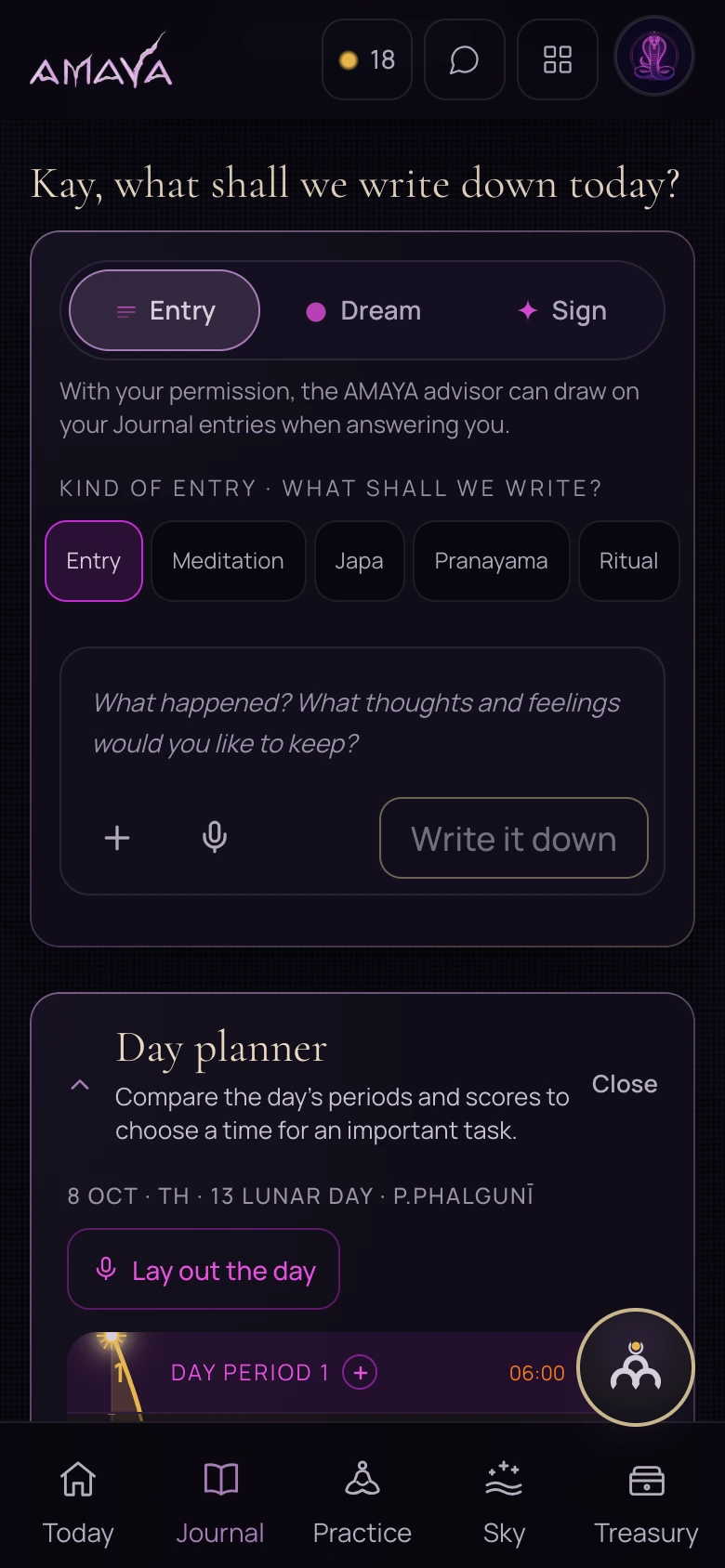
Open the Entry tab in Journal. Save the episode and the phrase you want to try in similar circumstances. You can use the outline in this article as four short questions: what happened; what I thought; what I did; and which response I will consider next time.
After a similar conversation, return to the observation. What matched the earlier scene? What was different? Was the prepared phrase useful? If not, adapt it to the new circumstances.
An individual entry describes a particular occasion. Avoid treating it as a final verdict on your character or another person’s intentions. Several entries give you material to compare carefully, without a deadline by which the response must change.
 Open full size - in a new tab
Try it in AMAYA
Keep one episode and one alternative phrase in Journal. Compare concrete entries instead of giving yourself an overall score.
AMAYA Journal: keep a thought, dream or observation
Open Journal