Attention and everyday practice
How to set an intention and choose a first step
Name what matters to you, identify the part you can influence and choose your next action. Then return to the facts: what you did and what changed.
- What matters
- What I can influence
- What I will do next
‘I want things to change’ can be sincere without telling you where to begin. An intention becomes clearer when it includes a direction, your own participation and a manageable step.
Begin with what matters to you
Ask yourself why this matters now. What would an ordinary day look like if you made room for it? What would you like to change in your own actions? Answer in plain words, without a formal declaration.
For example, ‘I want more clarity’ might mean wanting to discuss working arrangements calmly. Your next task could be gathering your questions and arranging the conversation.
Begin with one area: work, relationships, your daily routine or a personal project. If one sentence includes your whole life, choose the part you are ready to return to today. You can refine your intention as circumstances change.
Check your intention against three practical points
Your participation
Name what you can do yourself. Other people's decisions and external events are not fully within your control.
A concrete step
Choose an action you can begin in clear circumstances: open a document, prepare a question or set aside time.
A way to return
Decide when to reread the entry and look at the facts. The date is a point for review, not a promise of an external result.
What this looks like in everyday life
These are example wordings for learning. They are not user stories or results from the app.
A useful first step makes the starting point clear. “Become a different person” leaves that unclear. “Open a note and write three questions” gives you something to do. The other person may still decline a meeting, and the agreement may differ from what you hoped for.
| Initial wish | What matters | Next action |
|---|---|---|
| I want to be valued at work | Clear agreements about my role and workload | Write three questions about my responsibilities and suggest a time to talk |
| I want more closeness | Time for a calm conversation and mutual attention | Suggest an evening together and ask whether it suits the other person |
| I want to practise regularly | A practice that fits into my day | Choose a familiar short practice and a suitable time for it |
Compare the intention with experience
Record actions, observations and interpretations separately. ‘Sent three proposals’ is an action. ‘Received one reply’ is an observation. ‘This means I am heading in the right direction’ is your interpretation, which still needs examining.
You can note a coincidence as personally meaningful while keeping that distinction. A coincidence alone does not demonstrate that an intention changed external events.
If circumstances change, refine your wording. Letting go of an unsuitable step can also be a considered decision.
If you keep putting off the first step
The step is too large
Reduce it to the beginning of an action. Instead of “sort out everything”, choose one list or one email. Check that you know what to open and where to begin.
You need another person’s response
Write down what you can ask for, leaving the other person free to agree or decline. While you wait, choose something you can do without their response.
The direction no longer fits
Ask what has changed: your circumstances, your options or the wish itself. Refine your wording. Your earlier wording does not oblige you to continue along an unsuitable path.
What to write in AMAYA Journal
Open Journal and select the Entry tab. An ordinary text entry is enough for this note. Answer four questions: what matters to me; what action I will choose; when I will return to the entry; and what actually happened.
For example: “I want to discuss my workload calmly. Today I will write my questions; tomorrow I will suggest a time to talk. On Friday I will return to this entry.” After the conversation, create a new entry with the facts and your next step. Briefly restate the original intention at the start.
Use your own words. In each entry, connect the intention, your action and what you noticed. When you revisit the topic, you can see what has changed.
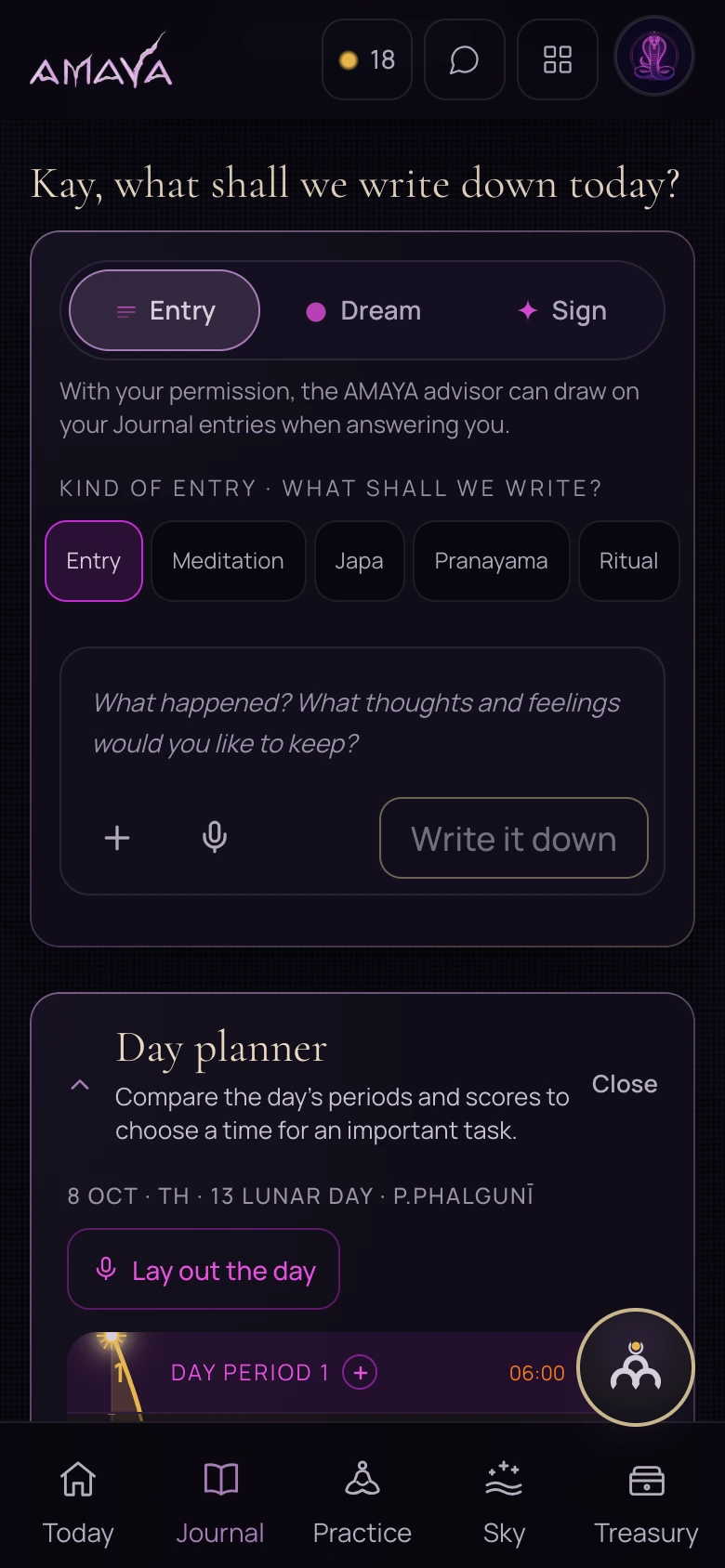 Open full size - in a new tab
Try it in AMAYA
Open Journal and save your wording in the Entry tab. The Journal guide shows the screen and the sequence of actions.
AMAYA Journal: keep a thought, dream or observation
Open Journal