Attention and everyday practice
Tantra in AMAYA: perception, practice and everyday life
AMAYA teaches that perception and manifestation are two sides of one movement. You can begin exploring the idea through ordinary experience: saying and hearing a word, touching an object or looking at something nearby.
- Notice what is happening
- Observe your own participation
- Choose an action
In a conversation, you hear another person, choose your words and affect the exchange with your reply. This familiar situation holds the question explored here: how does what comes to you relate to your own participation? This introduction presents AMAYA's approach and a few ways to observe everyday experience.
The idea AMAYA explores
In Kalanath D'Aysén's teaching, the world is understood as the manifestation of living, active Consciousness. Shiva and His Force are inseparable; perception and manifestation form one movement. This is the philosophical basis of AMAYA's teaching.
The approach brings attention to the whole of life: the body, work, relationships, rest, desires and choices. Practice continues in how you speak, treat other people and act after reading.
This short introduction has a specific purpose: to make that connection easier to understand through accessible examples. Personal observation reveals how an individual moment is experienced. By itself, it does not scientifically establish an entire account of reality.
Three terms in plain language
Unfamiliar words become easier to understand beside the experience they describe. These three working explanations are enough to begin.
| Term | What it means here |
|---|---|
| Perception | How events become part of your experience: a voice you hear, an object you see or the sensation of touch. |
| Manifestation | In AMAYA's teaching, the active aspect of Consciousness. In a conversation, begin with something observable: your own voice, gesture or reply. |
| Practice | Sustained work with attention and action within the teaching. The short observations below introduce a question explored in greater depth later. |
A word, touch and sight: where to begin
Choose one example that feels comfortable now. Keep an ordinary posture and breathe as usual. The aim is to notice what happens; you do not need to produce a special sensation.
Say and hear a word
Say a short word, such as “home”, in your normal voice. Notice the sound of your own voice as you speak. Repeat if you wish. What could you notice about speaking and listening together?
Touch a familiar object
Rest your hand on a table or hold a mug at a comfortable temperature. Notice its surface and the pressure where you make contact. That contact includes your movement towards the object and the sensation you receive.
Look at something nearby
Choose an ordinary object. Notice its colour and shape, then attend to the act of looking itself. Move your gaze and blink as usual. Keep only the observation that actually arises.
Bring the question into an everyday conversation
Imagine a conversation at work: someone is still explaining a task, and your reply is already forming. Notice both parts of the moment: what you are hearing and what you intend to add. You might then let them finish, ask a question or respond.
This example makes your participation in a situation easier to notice. It leaves room for the circumstances and the other person's response: several people contribute to the outcome.
Afterwards, recalling one concrete detail is more useful than judging the “depth” of your experience. For example: “At first I wanted to interrupt. After asking a question, I understood which deadline we were discussing.” This is a teaching example written for the article.
What to record in Journal
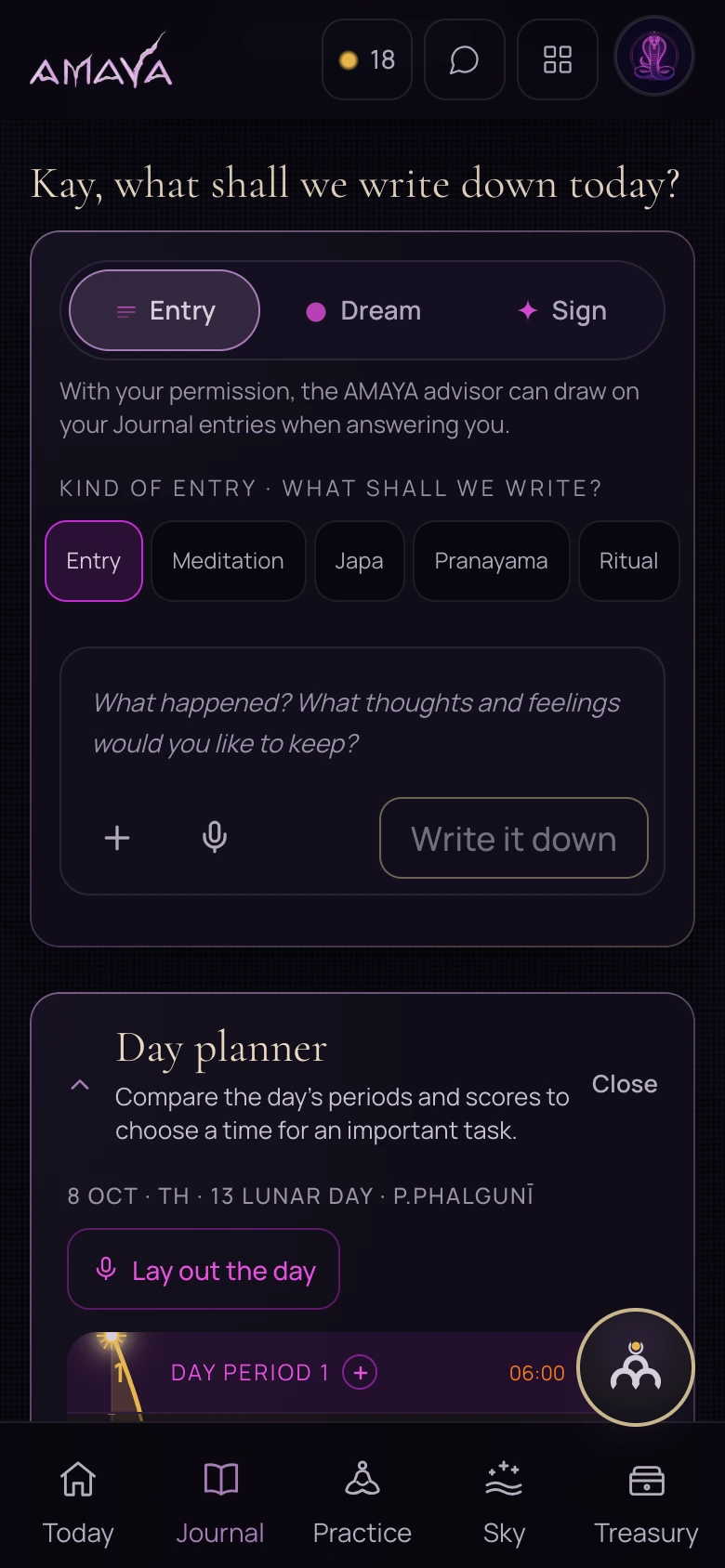
Three short lines are enough: the situation, an observation and the next step. In AMAYA, you can enter them as an ordinary Journal note. There is no separate test of whether your experience was correct.
A teaching example: “We discussed a deadline. I was preparing my reply while the other person spoke. Next time I will first ask what needs to be ready by that date.” The note brings you back to a concrete action you can recall later.
The image shows a saved Journal screen. The example in this article was not entered in the app. A separate walkthrough explains how to use the section.
 Open full size - in a new tab
Continue exploring the teaching
AMAYA presents tantric practice as a connected system: an understanding of Consciousness, and work with perception, the body, sound and action. This introduction focuses on perception and manifestation; other aspects need their own explanation and context.
The public Path page introduces the structure of learning. Full guidance and materials passed on within the tradition follow their own sequence of study. A short exercise cannot establish readiness for them or replace personal guidance.
Choose what interests you as a next step: repeat one observation, save a specific note or read about the Path. You can continue exploring at your own pace.
Try it in AMAYA
Open the Journal walkthrough to save your observation. The AMAYA Path page explains the structure of learning.
AMAYA Journal: keep a thought, dream or observation
Open Journal